
Your shop lot has half a dozen rat entry points you've never noticed — and the next health inspection or fire is going to be expensive. Here's a 10-minute audit of the common entry points in Klang Valley shop-lot construction, and the cheap fixes that block them.
Why this matters more for shop lots than houses
Residential rat problems are a nuisance. Shop-lot rat problems can kill your business — particularly if you're in F&B. An MOH inspector spotting droppings near food storage can trigger a closure order. A rat chewing through wiring in your ceiling void can start an electrical fire after hours. And rodent droppings in stockroom inventory means write-offs.
The good news: most shop lots have the same six entry-point patterns. If you audit and fix all six, you've eliminated the vast majority of risk.
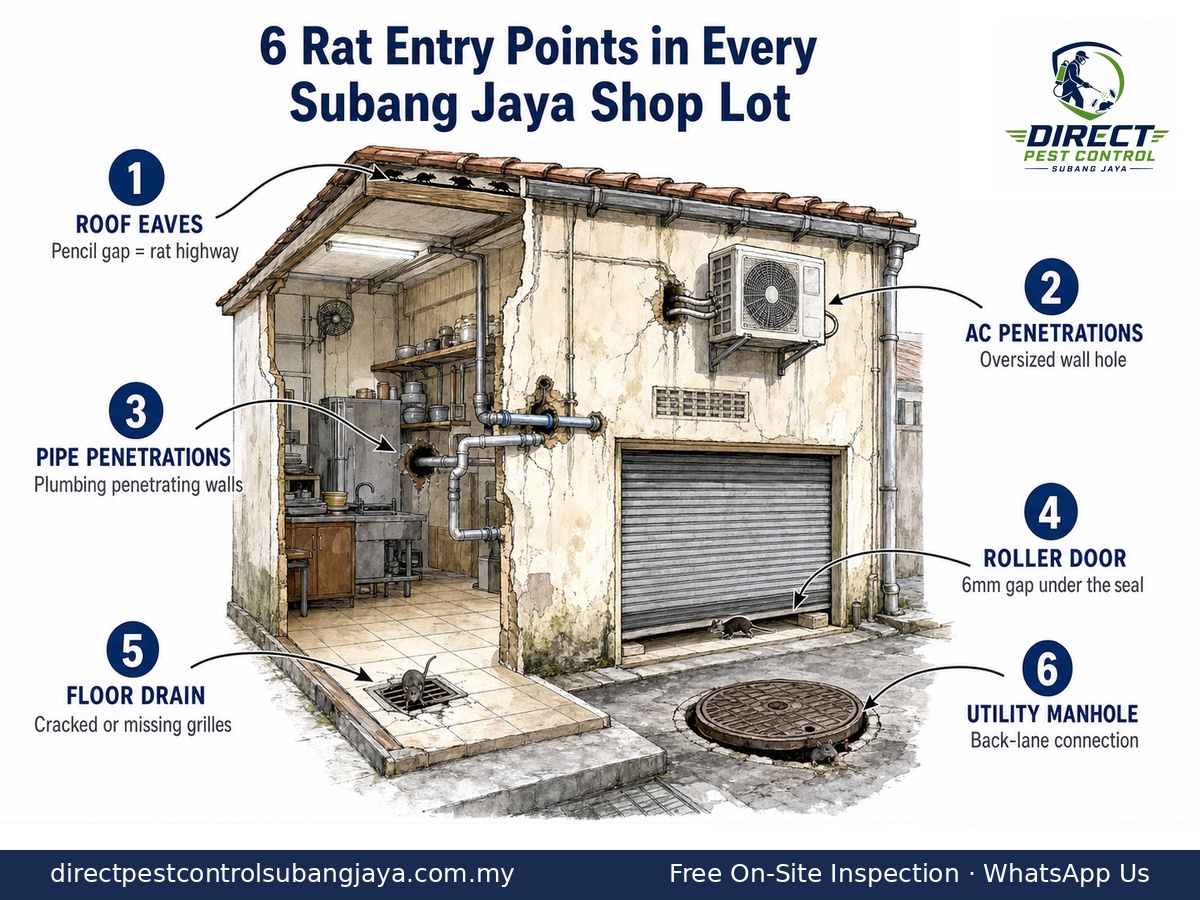
1. The roof-eave gap (highest priority)
Walk outside your shop. Look up at where the roof meets the front wall — particularly at the corners. In most Klang Valley shop-lot construction, there's a 2-4cm gap between the top of the wall and the underside of the roof tile that's notionally sealed with cement or fascia board. After 10 years, that seal cracks. Rats walk straight in along the wall.
Cheap fix: ½-inch steel mesh stuffed into the gap and sealed with mortar. Done from a step ladder in 30 minutes.
2. Pipe penetrations through walls
Every shop has water pipes, gas lines and electrical conduit penetrating the perimeter walls. The hole is always slightly bigger than the pipe — that's the rat highway. Crouch and look at every wall penetration in your stockroom, kitchen and toilet.
Cheap fix: Steel wool stuffed around the pipe + expanding foam to seal + a smear of cement skim coat. Done.
3. Rear roller-door bottom seal
The back roller door of most shop lots has a rubber bottom seal that's degraded after years of opening and closing. If you can fit your little finger under the closed door, a young rat can too.
Cheap fix: Replace the bottom rubber strip with a heavy-duty brush-bristle door seal. RM 40 at a hardware store, 10 minutes to fit.
4. Floor drain grilles with cracks or gaps
Walk your kitchen and toilet floors. Every floor drain should have a tight grille — if the grille is cracked, slipping or missing entirely, rats from the back-lane drain network walk straight up.
Cheap fix: Replace the grille; or use a one-way valve drain insert that lets water through but blocks rats.
5. Air-conditioner wall penetrations
Every wall-mounted AC has a through-wall hole for the refrigerant lines. Old installations leave that hole oversized and stuffed with rags, which rats happily chew through.
Cheap fix: Steel-wool plug around the lines + foam sealant + paintable cement skim coat outside.
6. Back-lane utility manhole near your unit
Loose or broken back-lane manhole covers connect directly into the city drain network. They're not your responsibility to fix, but their proximity to your back door affects your rat pressure. Report to local council and consider an external bait station nearby.
The professional follow-up
Auditing and sealing solves the entry problem. To remove the rats already inside, you need targeted rat and rodent control — exterior tamper-proof bait stations on the back-lane side, indoor trapping where appropriate, and a return visit to confirm activity has stopped. For F&B operators we issue a written service report suitable for MOH inspection follow-up.
The shop lot that gets a rat infestation isn't unlucky — it's the one with the gaps the neighbour fixed. Auditing your six entry points is the cheapest insurance policy you can buy.